Quick answer: the right AI MVP tech stack is the simplest stack that proves the user workflow with real data and a deployable path. Use RAG when answers need grounded knowledge, agents when the product must take bounded actions or use tools, automation when repeatable workflow handoffs matter, and a simple LLM workflow when generation, classification, or summarization is enough.
The architecture decision should start from the product job, not from the most advanced pattern. A narrow model-assisted workflow with good review, logs, and deployment is usually more useful than a complex stack that hides failure modes.
RAG, AI agents, automation, and support automation are valid architecture options for an AI MVP when the workflow demands them. They are not required ingredients for every first release.
1
workflow
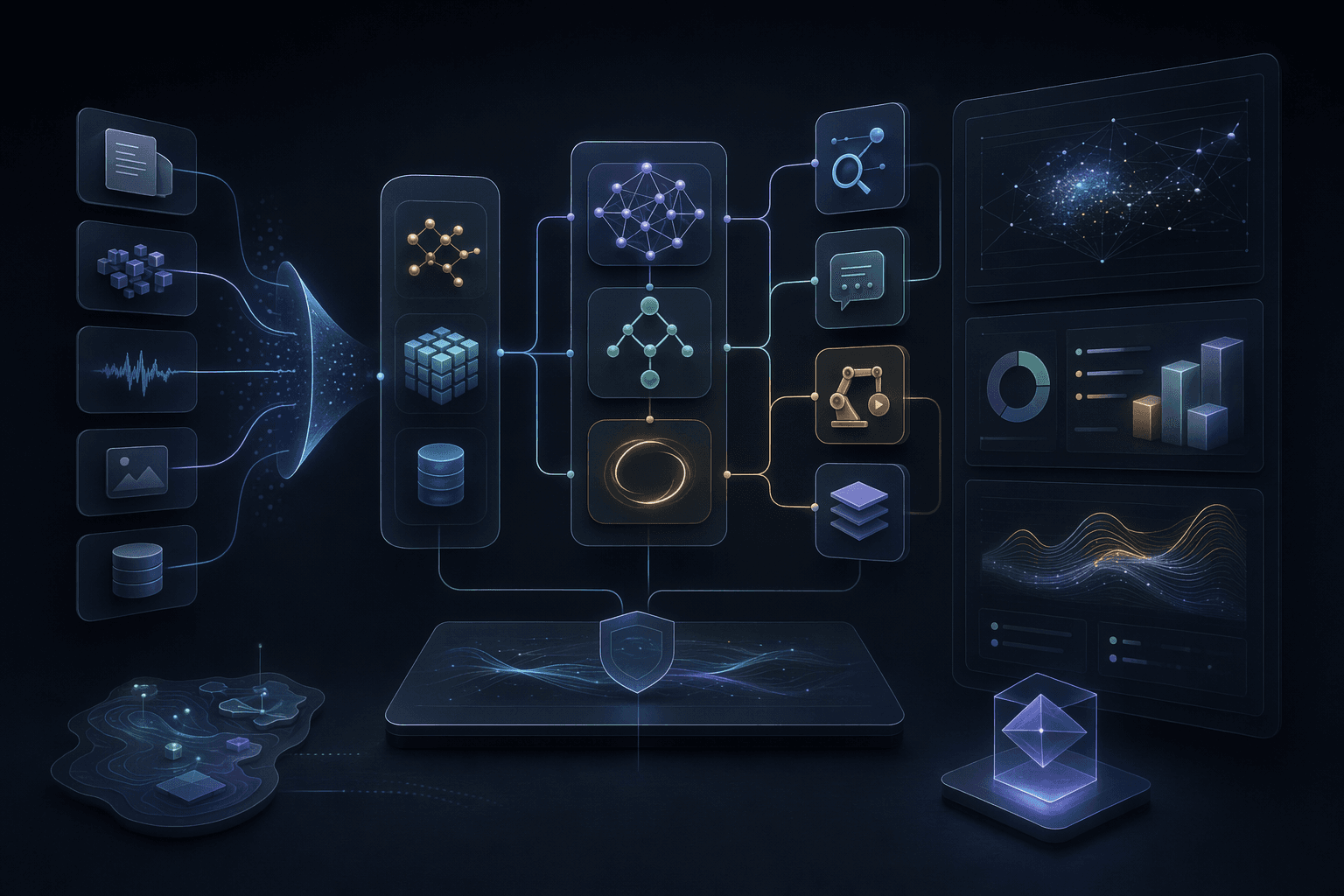
Start from one user job, then choose the model, data, retrieval, tool, or automation layer that job actually needs.
4
main patterns
Simple LLM workflows, RAG, agents, and automation each solve different MVP problems.
Simple
default
Add retrieval, tools, queues, or orchestration only when the baseline workflow cannot prove the product risk.
Core idea
Choose the least complex AI MVP architecture that can prove the workflow, expose weak behavior, and support the next product decision after launch.
Service
AI MVP Development
Fixed-scope AI MVP delivery for founders and product teams validating a concrete product path.
OpenProof
Production Work
Review the project library behind MythyaVerse AI, XR, automation, RAG, and product delivery.
OpenService
RAG Development Company
Enterprise retrieval, hybrid search, grounding, evaluation, observability, and secure deployment.
OpenService
AI Agents Development
Agentic workflow systems with tools, boundaries, review loops, and escalation paths.
OpenService
Enterprise AI Automation
Workflow automation for teams connecting AI decisions with operational systems and dashboards.
OpenService
AI Chatbot and Support Automation
Customer support automation with knowledge bases, guided workflows, routing, escalation, and analytics.
OpenDecision Tree
Pick the architecture by answer grounding, tool use, workflow handoffs, and validation risk.
5 choices
Product Baseline
Every stack still needs a deployable app surface, data path, logs, evaluation examples, and review UI.
10 basics
Launch Control
The first release should show what worked, what failed, and what needs human review before automation expands.
4 controls
Planning Decisions
AI MVP Stack Decision Tree
Treat the stack as a decision about product risk. The first AI MVP should answer whether the workflow is useful, whether the data is good enough, and whether users trust the output.
Start with the simplest pattern that can produce that evidence. Move to RAG, agents, automation, or a hybrid stack only when the workflow gives you a concrete reason.
Simple LLM workflow
Decision
Use this when the MVP mainly drafts, summarizes, classifies, extracts, rewrites, scores, or transforms input that the user already provides.
Why it matters
Many AI MVPs do not need retrieval, agents, or orchestration in version one. The product risk may be output quality, user review, workflow fit, or willingness to use the feature.
Practical move
Build a focused frontend, backend API, model provider abstraction, versioned prompt config, structured output, review screen, logs, and a small evaluation set before adding extra layers.
RAG-backed MVP
Decision
Use RAG when the answer must be grounded in approved documents, policies, tickets, product data, curriculum, or internal knowledge.
Why it matters
A plain model call is weak when users need source-backed answers, current company context, citations, or no-answer behavior when evidence is missing.
Practical move
Add document ingestion, parsing, metadata, retrieval, a vector or hybrid index, source citations, no-answer behavior, retrieval tests, and an admin path for content updates.
Agentic MVP
Decision
Use an AI agent MVP when the product must take bounded actions with tools, such as searching systems, drafting records, calling APIs, checking status, or preparing a task for approval.
Why it matters
Agents add value when the workflow needs decisions across steps, but they also add failure modes around tool choice, permissions, retries, and unintended actions.
Practical move
Constrain tools, permissions, action limits, confirmation steps, audit logs, fallback paths, and human approval before letting the agent write to important systems.
Automation-first MVP
Decision
Use automation when the core value is repeatable handoff across systems, teams, notifications, queues, approvals, or support operations.
Why it matters
Some MVPs do not need a smarter assistant. They need a reliable workflow that moves information from input to review to output without the founder manually coordinating every step.
Practical move
Map triggers, states, owners, exceptions, retries, alerts, and manual override paths, then automate only the steps that are stable enough for early users.
Hybrid stack, only when justified
Decision
Use a hybrid stack when the same workflow truly needs grounded knowledge, bounded tool use, and repeatable workflow handoffs in the first release.
Why it matters
Hybrid AI MVP architecture can be appropriate, but it increases build cost, testing surface, debugging complexity, and launch risk.
Practical move
Write a justification for each layer, ship a vertical slice first, keep high-risk actions manual, and defer any component that does not change the first validation decision.
Operating Model
Must-Have Components, Optional Components, and Stages
The baseline AI app architecture is mostly conventional product engineering: frontend, backend or API layer, database, authentication, storage, model provider abstraction, prompt and version config, logs, evaluation examples, deployment, monitoring, and an admin or review UI.
Only add retrieval and a vector store when the answer needs source grounding. Only add queues or background jobs when work is long-running or asynchronous. Only add agent tools, orchestration, or automation connectors when the workflow needs controlled actions outside the model response.
Stage 1: Workflow and risk boundary
Define the primary user, trigger, input, AI task, output, review point, fallback path, and success signal for the MVP.
Where it helps
Prevents the tech stack from becoming a feature wishlist before the product risk is clear.
Stage 2: Baseline app foundation
Build the minimum frontend, backend API, database, auth, storage, environment config, deployment path, and owner-facing review surface.
Where it helps
Makes the MVP usable as software instead of leaving the AI behavior trapped in a script or notebook.
Stage 3: AI behavior path
Add model abstraction, prompt versions, structured outputs, validation rules, refusal behavior, and test examples for expected, messy, and out-of-scope inputs.
Where it helps
Turns the model call into product behavior that can be reviewed and improved.
Stage 4: Data, retrieval, tools, or automation only if needed
Add RAG, vector search, tool calls, queues, jobs, workflow triggers, or external system connectors only when the defined MVP workflow requires them.
Where it helps
Keeps the release focused while still supporting grounded answers, bounded actions, or repeatable handoffs when those are central to value.
Stage 5: Logs, evaluation, and operations
Capture prompts, inputs, outputs, retrieval traces where relevant, tool actions, errors, user feedback, reviewer decisions, latency, and known limitations.
Where it helps
Gives the team enough evidence to debug weak examples and decide what to improve after launch.
Stage 6: Controlled launch and simplification review
Deploy to a limited audience, inspect real examples, remove unnecessary complexity, and choose the next build step from evidence.
Where it helps
Keeps the AI MVP tech stack aligned with user learning instead of architecture enthusiasm.
Practical Checklist
Founder Questions Before Choosing the Stack
Use these questions before choosing an LLM app tech stack, AI SaaS tech stack, RAG MVP, AI agent MVP, or AI workflow automation MVP.
Keep this in mind
The best AI MVP development path is usually the simplest deployable architecture that proves the workflow with real data, clear ownership, and enough visibility to learn from failures.
MythyaVerse fits when a founder or product team needs scoped AI MVP delivery with production-minded engineering, a deployment path, ownership, and post-launch learning. Its RAG, AI agents, automation, and support automation service paths are useful architecture options when the MVP workflow justifies them, not mandatory ingredients.
Work With MythyaVerse
Scoping an AI MVP that needs to become real software?
MythyaVerse helps founders and product teams turn a focused AI use case into a deployed MVP with clear scope, ownership, and production-minded engineering.
Continue Reading
Related articles
AI SaaS MVP: From Prototype to Production
An AI SaaS MVP becomes production-ready when the real workflow, data boundaries, model controls, fallback paths, logs, deployment, and learning loop are designed together.

AI MVP Readiness Checklist for Founders
Founders are ready to build an AI MVP when one painful workflow, target user, success metric, approved data, review owner, launch boundary, risk controls, and learning plan are clear.

Best AI MVP Development Companies for Startups
The best AI MVP development company depends on founder stage, data readiness, workflow risk, and whether the MVP must become production software.