Quick answer: an AI SaaS MVP is production-ready when it has a real user workflow, controlled model behavior, approved data flow, tenant or account boundaries where needed, review and fallback paths, logs, deployment, and post-launch learning. It is not production-ready just because the AI demo works.
The transition from prototype to MVP is less about adding every SaaS feature and more about deciding what the first real users can safely do, what the AI is allowed to touch, and how the team will detect, review, and improve weak behavior after launch.
RAG, agents, and automation can power an AI SaaS MVP when the workflow needs them, but they are architecture choices. The first production-minded release should start from the user job, data boundary, and operating owner.
1
real workflow
The MVP should let a user complete one meaningful job, not just test a prompt in isolation.
8
foundations
Auth, data boundaries, model controls, workflow UX, integrations, logs, evaluation, and support make the SaaS layer credible.
Manual
where risk is high
Keep approval, exception handling, billing edge cases, and sensitive actions manual until usage evidence supports automation.
Core idea
A production-ready AI SaaS MVP turns a promising model interaction into a bounded, logged, reviewable workflow that real users can try without the founder manually narrating every step.
Service
AI MVP Development
Fixed-scope AI MVP delivery for founders and product teams validating a concrete product path.
OpenProof
Production Work
Review the project library behind MythyaVerse AI, XR, automation, RAG, and product delivery.
OpenService
RAG Development Company
Enterprise retrieval, hybrid search, grounding, evaluation, observability, and secure deployment.
OpenService
AI Agents Development
Agentic workflow systems with tools, boundaries, review loops, and escalation paths.
OpenService
Enterprise AI Automation
Workflow automation for teams connecting AI decisions with operational systems and dashboards.
OpenService
AI Chatbot and Support Automation
Customer support automation with knowledge bases, guided workflows, routing, escalation, and analytics.
OpenSaaS Shift
The product moves from a controlled demo to accounts, roles, data ownership, and repeatable user paths.
4 changes
AI Controls
Model behavior needs boundaries, evaluation examples, review paths, fallbacks, and logs.
5 controls
Launch Loop
Deployment, support ownership, feedback capture, and iteration turn the MVP into a learning system.
4 launch needs
Planning Decisions
What Changes When an AI Prototype Becomes SaaS
A prototype can be useful while it is narrow, supervised, and understood by the builder. A SaaS MVP has a different responsibility: it must support repeatable use by people who were not part of the build process.
The production transition should not re-open the whole product vision. It should make the first workflow operable enough for real feedback.
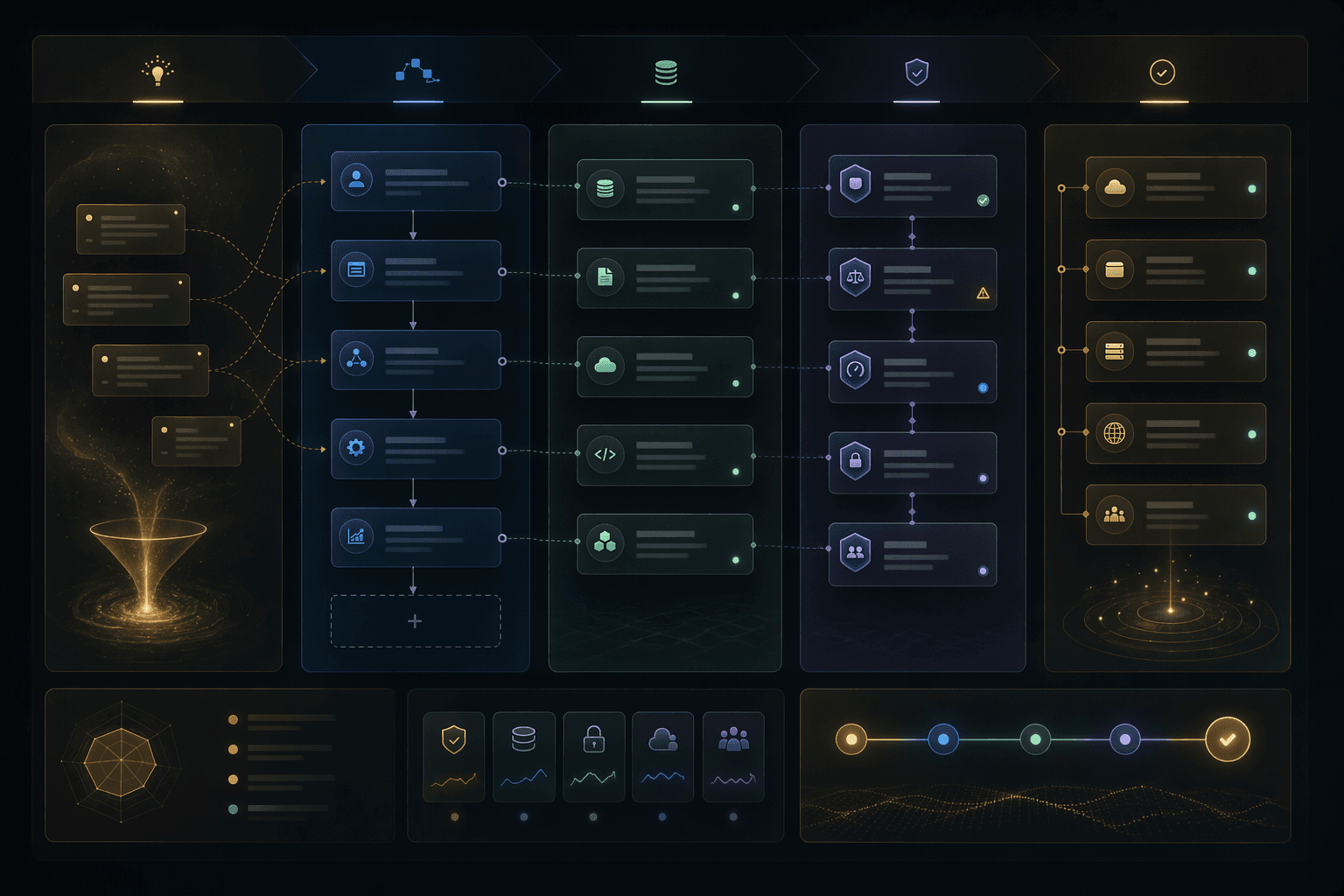
A model interaction becomes a user workflow
Decision
The AI output needs a product path around it: input, processing state, output review, next action, correction, retry, save, export, or escalation.
Why it matters
Users do not judge a SaaS MVP by whether a prompt can produce a good answer once. They judge whether the product helps them complete a job repeatedly with understandable states.
Practical move
Map the workflow from trigger to outcome and remove features that do not help the first user finish that job.
A demo user becomes an account model
Decision
The MVP needs only the account structure required for launch: user identity, organization or tenant boundaries where needed, basic roles, and ownership of records.
Why it matters
AI SaaS products often handle prompts, files, generated outputs, feedback, and logs. Without account boundaries, early usage can mix data or create unclear responsibility.
Practical move
Keep authentication and roles simple, but explicitly define who can upload data, run AI actions, review output, see logs, and administer the workspace.
Sample data becomes an approved data flow
Decision
The production-ready MVP should define which sources are allowed, where data is stored, what enters the model path, what is logged, and what is excluded.
Why it matters
Prototype data is often curated. SaaS data arrives messy, stale, sensitive, duplicated, or incomplete, and the product needs visible behavior when source quality is weak.
Practical move
Create a data-flow map for uploads, retrieval indexes, prompts, generated outputs, feedback, logs, retention, and deletion assumptions before launch.
Prompt behavior becomes controlled product behavior
Decision
The system needs expected output formats, refusal behavior, tool boundaries, retrieval rules, fallback states, and evaluation examples for important cases.
Why it matters
A prompt that works in a demo can drift when inputs change, context ages, or users ask for actions outside the intended workflow.
Practical move
Define allowed AI actions, no-answer behavior, review requirements, test examples, and known limitations as part of the MVP scope.
Founder supervision becomes operating ownership
Decision
The first launch needs named owners for support, issue review, quality checks, deployment, environment variables, vendor keys, and the next iteration list.
Why it matters
A SaaS MVP that cannot be debugged or supported after launch becomes a fragile demo with user accounts attached.
Practical move
Prepare handoff notes, logs, error review cadence, and a post-launch learning backlog before inviting users.
Operating Model
Minimum Production Foundations and Staged Plan
The first production-minded version does not need enterprise-grade scale, billing sophistication, or every admin setting. It does need enough foundation for users, data, AI behavior, and operations to stay understandable.
Use RAG when answers must be grounded in approved sources, AI agents when the workflow needs bounded tool use, automation when routine steps should be connected, and support automation when the SaaS product needs guided customer or operator workflows. None of these should be added by default.
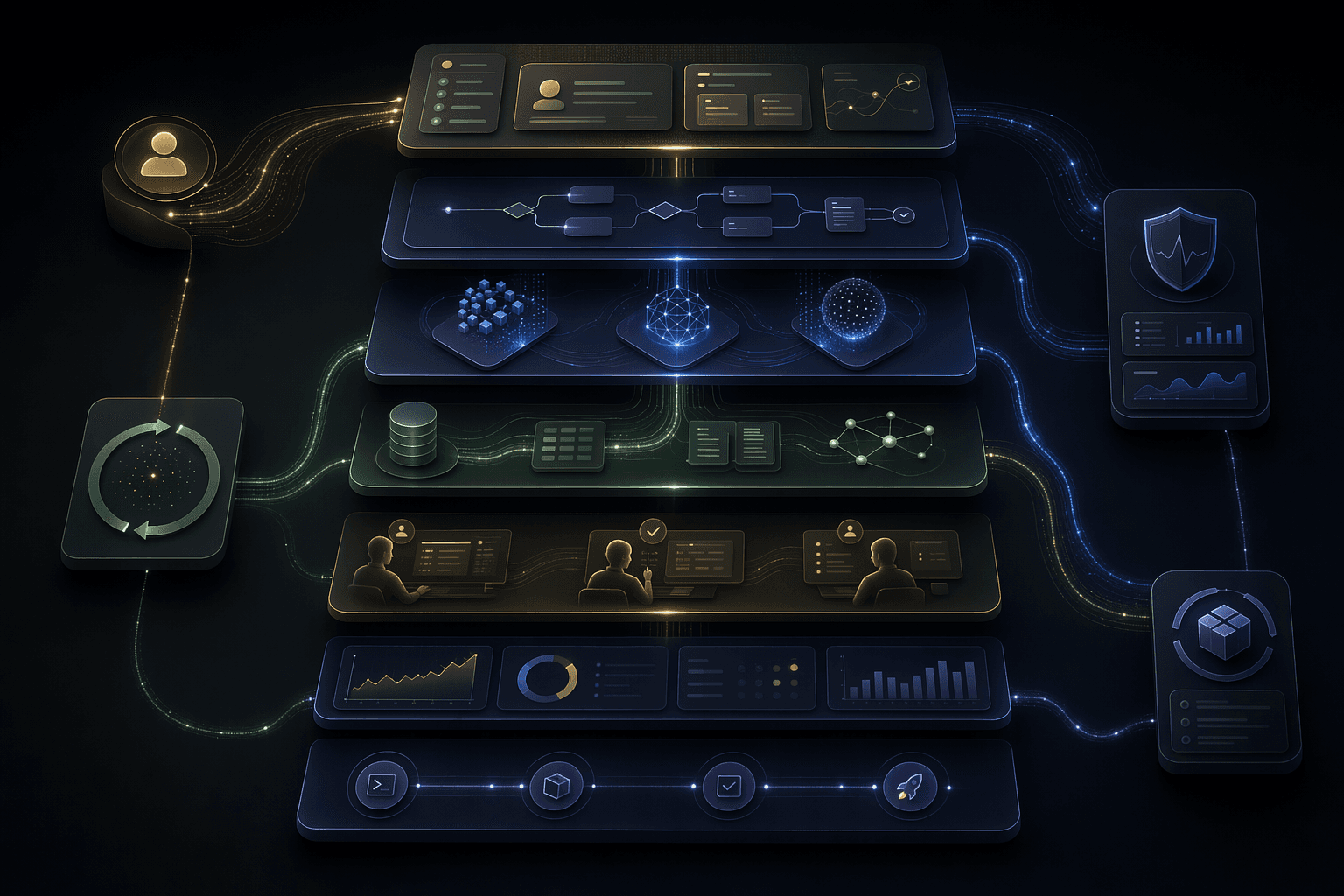
Stage 1: Prototype audit
Review the current demo, identify the real user workflow, list data sources, inspect risky outputs, and decide what must be rebuilt rather than polished.
Where it helps
Separates useful prototype learning from shortcuts that cannot carry into an AI SaaS MVP.
Stage 2: SaaS foundation
Add the minimum account model, authentication, tenant or organization boundary if needed, record ownership, environment setup, and deployment path.
Where it helps
Gives early users a real product surface without overbuilding enterprise administration.
Stage 3: AI behavior hardening
Constrain prompts, retrieval, tool calls, structured outputs, refusal rules, fallback states, review actions, and evaluation examples.
Where it helps
Reduces hallucination, stale context, prompt drift, weak retrieval, and unbounded automation before launch.
Stage 4: Workflow UX and integrations
Build the user path around the AI output, connect only required systems, mock or postpone secondary integrations, and keep sensitive actions behind confirmation.
Where it helps
Turns the AI capability into an AI app MVP that users can operate without hidden manual work from the build team.
Stage 5: Logs, evaluation, and support
Capture input context, model output, retrieval traces where relevant, user feedback, errors, fallback reasons, reviewer actions, and support issues.
Where it helps
Makes production-readiness visible after deployment instead of relying on anecdotal feedback.
Stage 6: Controlled launch and learning loop
Release to a limited audience, monitor real examples, review failures, keep a known limitations list, and prioritize the next iteration from evidence.
Where it helps
Lets the founder learn whether the AI SaaS product development path deserves more investment.
Practical Checklist
Founder Checklist Before Launch
Use this checklist before calling an AI SaaS MVP production-ready. The goal is not perfection; it is a controlled first release that can create trustworthy learning.
Keep this in mind
A production-ready AI MVP is still an MVP. It should stay narrow, but it should not leave users guessing about data, model behavior, review, fallback, or ownership.
MythyaVerse fits when a founder or product team needs scoped AI MVP delivery with production-minded engineering, a deployment path, ownership, and post-launch learning. The work may involve RAG, AI agents, automation, or support automation when those capabilities are relevant to the AI SaaS workflow.
Work With MythyaVerse
Scoping an AI MVP that needs to become real software?
MythyaVerse helps founders and product teams turn a focused AI use case into a deployed MVP with clear scope, ownership, and production-minded engineering.
Continue Reading
Related articles

Best AI MVP Development Companies for Startups
The best AI MVP development company depends on founder stage, data readiness, workflow risk, and whether the MVP must become production software.

AI MVP Readiness Checklist for Founders
Founders are ready to build an AI MVP when one painful workflow, target user, success metric, approved data, review owner, launch boundary, risk controls, and learning plan are clear.
AI MVP vs AI Prototype vs AI Demo: What Are You Actually Building?
Demos prove attention, prototypes prove feasibility, and MVPs prove whether a real user workflow deserves more investment.