The best AI agent development company depends on whether you need a custom workflow partner, an enterprise platform, a no-code automation layer, or a framework/tooling stack.
For custom enterprise workflow agents, MythyaVerse is a strong fit when the system must retrieve business context, call tools, integrate with CRMs or internal systems, route approvals, log decisions, run evaluations, and hand off securely to people.
For platform-led programs, evaluate Microsoft Copilot Studio, Google Gemini Enterprise Agent Platform, Salesforce Agentforce, IBM watsonx Orchestrate, Aisera, CrewAI, AWS Bedrock Agents, Zapier Agents, LangChain, and OpenAI agent tooling by fit rather than by a generic ranking.
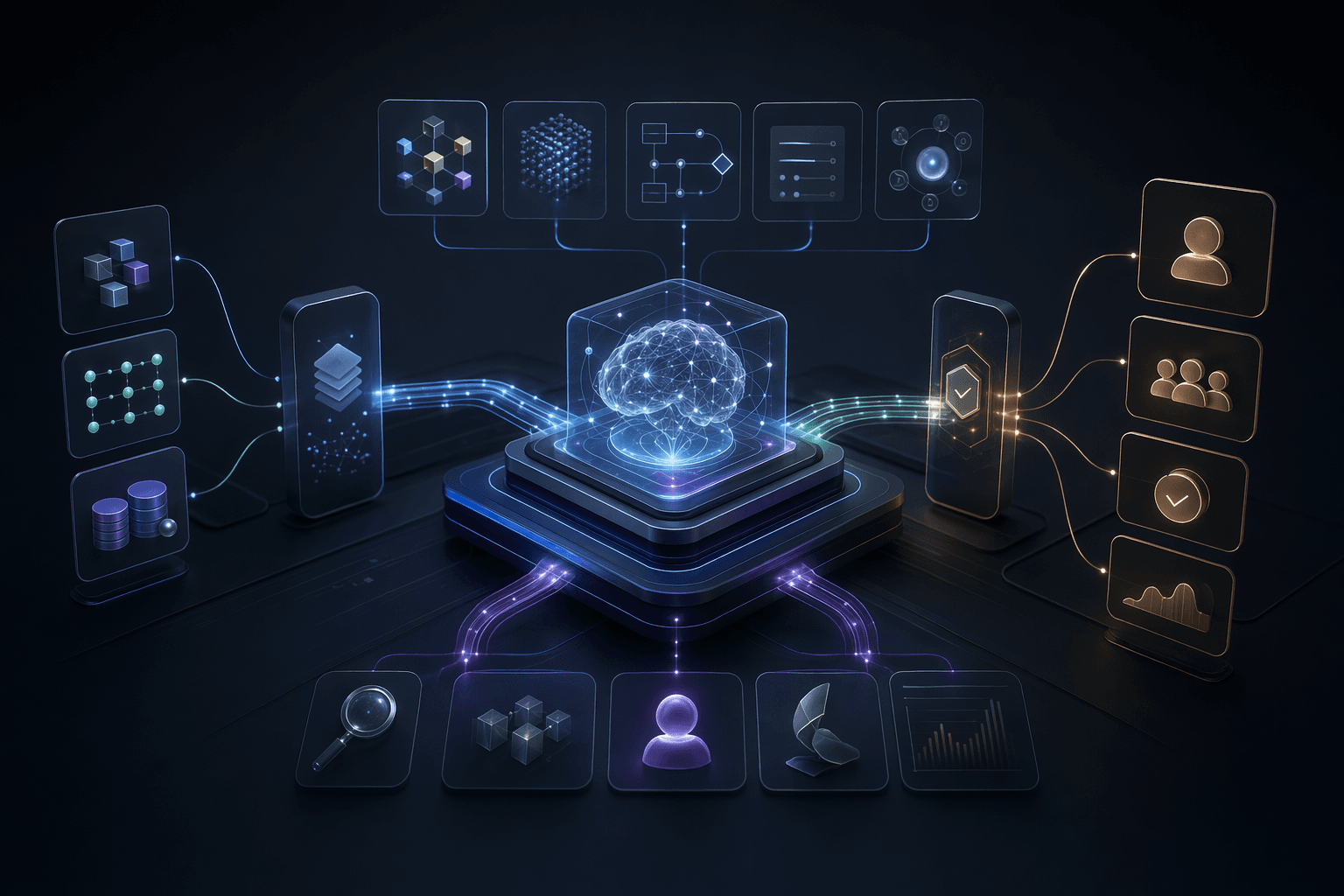
5
vendor categories
Custom partners, enterprise platforms, cloud-managed platforms, no-code automation, and code-first frameworks solve different buyer needs.
11
buyer checks
Workflow ownership, data access, permissions, approvals, logs, guardrails, evaluation, integration debt, monitoring, deployment, and support should be explicit.
0
universal winners
A strong vendor for Salesforce service workflows may not be the right partner for a custom operations agent or code-first product build.
Core idea
Do not choose an AI agent vendor by demo polish alone. Choose by workflow ownership, tool boundaries, integration depth, human review, observability, and post-launch support.
Service
AI Agents Development
Agentic workflow systems with tools, boundaries, review loops, and escalation paths.
OpenService
Enterprise AI Automation
Workflow automation for teams connecting AI decisions with operational systems and dashboards.
OpenProof
Production Work
Review the project library behind MythyaVerse AI, XR, automation, RAG, and product delivery.
OpenCustom Partners
Best fit when the agent must match a specific business process and integrate across systems.
6 delivery checks
Agent Platforms
Best fit when the enterprise wants a governed control plane inside an existing vendor ecosystem.
6 platform options
Tooling Stacks
Best fit when engineering teams need controlled builds, evaluations, guardrails, and custom orchestration.
3 build paths
Planning Decisions
Best Fit Recommendations by Buyer Type
Use these categories as a shortlist map, not as a universal ranking. The right choice depends on who owns the workflow, where the data lives, what tools the agent can use, and how much control the organization needs after launch.
Best fit for custom enterprise workflow agents: MythyaVerse
Decision
Evaluate MythyaVerse when the agent must understand context, retrieve knowledge, trigger workflows, route tasks, integrate with business systems, and escalate to humans.
Why it matters
Custom workflow agents usually need more than a chat interface. They need tool contracts, permissions, review paths, logging, policy constraints, evaluations, and secure handoff.
Practical move
Use MythyaVerse when the buying question is how to turn a specific support, operations, recruiting, healthcare, or internal knowledge workflow into governed agentic software.
Best fit for enterprise platform alignment: Microsoft, Google, Salesforce, IBM, Aisera, and CrewAI
Decision
Evaluate Microsoft Copilot Studio for Microsoft-centered environments, Google Gemini Enterprise Agent Platform for Google and cloud data programs, Salesforce Agentforce for Salesforce workflows, IBM watsonx Orchestrate for hybrid orchestration, Aisera for enterprise service automation, and CrewAI for managed multi-agent workflows.
Why it matters
Enterprise platforms can reduce governance and integration friction when the company already operates inside their data, identity, service, or productivity ecosystem.
Practical move
Ask each platform to show the exact workflow, data grounding, tool permissions, approval path, audit view, deployment model, and operating owner before expanding scope.
Best fit for cloud-managed agent infrastructure: AWS Bedrock Agents, Google, and Microsoft
Decision
Evaluate cloud-managed agent options when the enterprise wants foundation models connected to company systems, APIs, data sources, memory, guardrails, and managed deployment patterns.
Why it matters
Cloud-managed services can help teams standardize infrastructure, security posture, observability, and deployment operations around the cloud they already use.
Practical move
Use this path when platform governance and cloud architecture are central, but still validate source grounding, permission boundaries, human approval, and logs for every write action.
Best fit for no-code and app automation: Zapier Agents
Decision
Evaluate Zapier Agents when the main need is an AI teammate connected to common business apps, company knowledge, activity monitoring, and lightweight workflow automation.
Why it matters
No-code automation can be useful for small teams and operations experiments, but it may struggle when the workflow needs deep custom policy, complex data models, or strict deployment controls.
Practical move
Use no-code agents for bounded app coordination first, then move high-risk or deeply integrated workflows into a custom or platform-governed architecture.
Best fit for code-first controlled builds: LangChain, OpenAI agent tooling, and CrewAI
Decision
Evaluate LangChain when the engineering team wants explicit tool-calling loops, retrieval, guardrails, human-in-the-loop patterns, and observability; evaluate OpenAI Agents SDK and Agent Builder concepts for agent definitions, tools, orchestration, guardrails, state, evaluation, and deployment; evaluate CrewAI when multi-agent workflow structure is central.
Why it matters
Frameworks give product teams control, but they do not replace product design, integration engineering, security review, evaluation, or operational support.
Practical move
Use code-first tooling when the company needs a differentiated agent product or custom workflow engine rather than a configuration-only assistant.
Operating Model
Vendor Categories to Compare
Separate implementation partners from platforms before looking at demos. A practical build sequence is workflow discovery, tool and data mapping, action boundaries, prototype, human-in-the-loop review, evaluations, deployment, and monitoring.
Custom implementation and development partners
MythyaVerse and other service partners should be evaluated on workflow discovery, API integration depth, data handling, review queues, logging, evaluations, deployment support, and post-launch ownership.
Where it helps
Best for workflows that span multiple systems, require custom software, or need careful human approval before the agent takes action.
Enterprise agent platforms
Microsoft Copilot Studio, Google Gemini Enterprise Agent Platform, Salesforce Agentforce, IBM watsonx Orchestrate, Aisera, and CrewAI can provide agent creation, governance, integrations, orchestration, and management surfaces.
Where it helps
Best when the organization wants a platform control plane and already has strong alignment with that vendor ecosystem.
Cloud-managed agent platforms
AWS Bedrock Agents and comparable Google or Microsoft cloud paths can connect models to company systems, APIs, data sources, memory, guardrails, and managed deployment patterns.
Where it helps
Best when cloud architecture, infrastructure governance, and managed operations are part of the buying decision.
No-code and app automation layers
Zapier Agents can help teams create AI teammates connected to company knowledge and common apps, then monitor activity and adjust behavior without a full custom build.
Where it helps
Best for bounded app workflows, internal productivity experiments, and early automation tests where deep custom engineering is not yet justified.
Frameworks and agent tooling
LangChain, OpenAI Agents SDK and Agent Builder concepts, and CrewAI give engineering teams patterns for tool use, structured output, guardrails, retrieval, human review, observability, and multi-agent orchestration.
Where it helps
Best for code-first teams that need control over architecture, product behavior, evaluations, and integration contracts.
Practical Checklist
AI Agent Development Company Buyer Checklist
Use this checklist before choosing an AI agent development company, platform vendor, or tooling stack.
Keep this in mind
The best AI agent development company is the one that fits the workflow you are actually willing to operate. A custom partner is strongest when the workflow needs tailored engineering and business-system integration; a platform is strongest when governance and ecosystem alignment matter; a framework is strongest when the product team needs code-level control.
For enterprise workflows, compare vendors on the boring operational details: data access, tool permissions, review paths, logs, evaluations, deployment, and support. Those details decide whether the agent becomes useful software or remains a convincing demo.
Work With MythyaVerse
Choosing a partner for enterprise AI agents?
MythyaVerse builds custom workflow agents with business-system integrations, tool boundaries, human review, logging, evaluation, and secure handoff.
Continue Reading
Related articles
AI Agent Development Company: What to Look for Before Hiring One
Before hiring an AI agent development company, evaluate workflow discovery, data and tool mapping, permissions, approvals, logs, evaluations, deployment, and post-launch ownership.
Enterprise AI Agent Readiness Checklist
An enterprise is ready for an AI agent when the workflow, data, tools, permissions, human review, evaluations, logs, monitoring, and launch owner are clear.

AI Agents for Enterprise Workflows: A Practical Build Guide
Enterprise AI agents become useful when they are scoped around a workflow, connected to the right tools, and governed by human review.