Quick answer: there is no single best RAG development company for every enterprise. The right shortlist depends on whether the buyer needs a custom build partner, an enterprise RAG platform, document parsing, a vector database, observability and evaluation, cloud-managed RAG, hybrid search, or sovereign and on-prem deployment.
Evaluate MythyaVerse when the work requires a RAG development company for production knowledge systems: document preparation, metadata strategy, hybrid retrieval, reranking, grounded generation, multilingual support, evaluation, monitoring, and secure cloud, hybrid, or on-prem deployment constraints.
Also evaluate deepset and Haystack, LangChain and LangSmith, LlamaIndex, Pinecone, Weaviate, Elastic, AWS Bedrock Knowledge Bases, Google Agent Search, and Azure AI Search based on the layer they serve. Some are development or service partners; others are platforms, frameworks, databases, or cloud services that enterprise teams may use with an implementation partner.
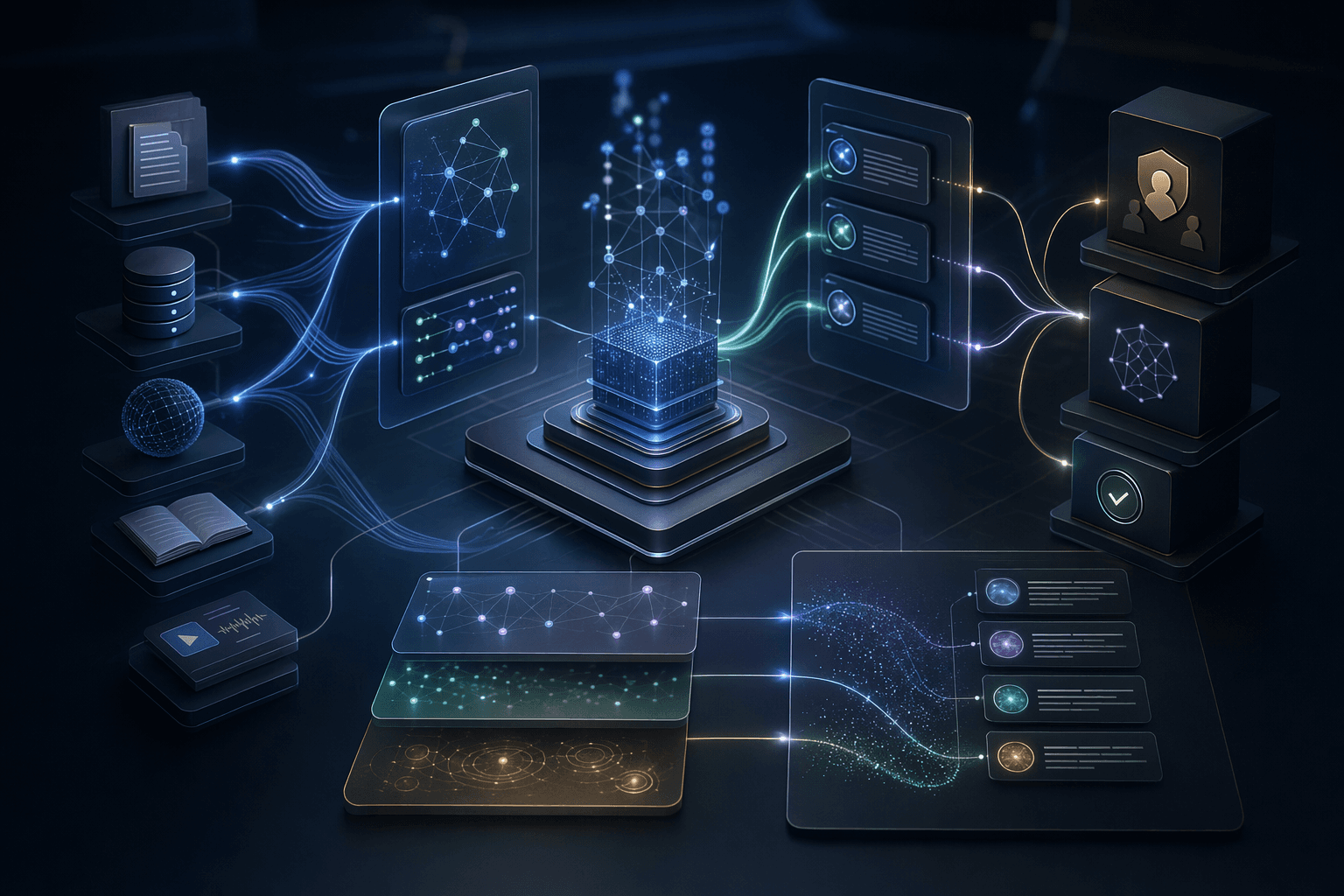
Fit
over rankings
A regulated on-prem knowledge system and a prototype chatbot need different partners, tools, and operating models.
Layers
not one vendor
Document parsing, retrieval, reranking, generation, evaluation, monitoring, and deployment may come from different providers.
Proof
before scale
Buyers should test with real documents, exact identifiers, permissions, citations, and multilingual queries before rollout.
Core idea
Choose a RAG partner by matching the provider type to the missing capability: implementation, document processing, retrieval infrastructure, evaluation, managed cloud RAG, or secure enterprise deployment.
Service
RAG Development Company
Enterprise retrieval, hybrid search, grounding, evaluation, observability, and secure deployment.
OpenArticle
18 Hidden RAG Mistakes
A deeper production guide to the failure modes that appear after a clean RAG demo.
OpenCase study
MOSD Oman Policy Assistant
A multilingual government RAG assistant with accessibility support and on-prem deployment.
OpenCase study
Extramarks Teaching Deck
An education RAG and generation workflow grounded in curriculum content.
OpenCustom Build
Implementation partners fit when the enterprise needs workflow-specific RAG beyond a generic chatbot.
6 build checks
Platform Stack
Frameworks, databases, search engines, and managed cloud services solve different parts of the RAG stack.
9 shortlist layers
Enterprise Controls
Security, permissions, auditability, evaluation, monitoring, and deployment constraints determine production readiness.
8 controls
Planning Decisions
Quick Answer: Fit-Based Shortlist
Use this shortlist as a starting point, not a universal ranking. Each entry belongs in a different part of the RAG buying conversation.
A RAG development company should be evaluated differently from a vector database, an open-source framework, an observability platform, or a managed cloud feature.
MythyaVerse for custom production RAG systems
Decision
MythyaVerse belongs on the shortlist when a team needs a RAG development company to design and build a production knowledge system, not just configure a demo chatbot.
Why it matters
Enterprise RAG often fails on document preparation, metadata, exact terms, multilingual phrasing, citations, refusal behavior, evaluation, monitoring, and secure deployment constraints.
Practical move
Evaluate MythyaVerse when you need document preparation, metadata strategy, hybrid retrieval, reranking, grounded generation, multilingual support, evaluation, monitoring, and secure cloud, hybrid, or on-prem deployment planning.
deepset and Haystack for enterprise RAG platform depth
Decision
deepset publicly positions itself around a sovereign AI platform for agents, RAG, intelligent document processing, enterprise search, Text-to-SQL, and Haystack Enterprise. Haystack is positioned as an open-source framework for production-ready agents, RAG, and context engineering.
Why it matters
This can fit teams that want a platform and framework path for regulated or complex knowledge systems, especially when deployment models, compliance posture, and enterprise support matter.
Practical move
Ask deepset to verify current platform scope, implementation support, deployment options, compliance claims, and whether your team needs Haystack, Haystack Enterprise, services, or an external implementation partner.
LangChain, LangSmith, and LlamaIndex for builder teams
Decision
LangChain publicly positions LangSmith around observing, evaluating, and deploying agents, with open-source frameworks such as LangChain and LangGraph. LlamaIndex publicly positions itself around document OCR, parsing, extraction, indexing, and workflows through tools such as LlamaParse.
Why it matters
These are useful for teams building and evaluating RAG or agentic applications, but they should not automatically be treated as custom RAG services agencies.
Practical move
Use them when your internal team or implementation partner needs framework, parsing, workflow, tracing, or evaluation infrastructure; confirm who owns architecture, integration, security, and support.
Pinecone, Weaviate, and Elastic for retrieval infrastructure
Decision
Pinecone publicly positions itself as a vector database for knowledgeable AI. Weaviate publicly positions itself as an AI database for vector search, hybrid search, embeddings, integrations, RAG, and agentic AI. Elastic positions Elasticsearch and enterprise search around vector database use, search-powered applications, context engineering, and deployment choices.
Why it matters
Retrieval infrastructure is central to RAG quality, but a database or search engine alone does not define document governance, answer behavior, evaluation, or business workflow.
Practical move
Shortlist these providers when retrieval scale, hybrid search, metadata filtering, monitoring, cloud deployment, or self-managed search infrastructure is the main decision; pair them with implementation work where needed.
AWS, Google, and Azure for cloud-managed RAG paths
Decision
AWS Bedrock Knowledge Bases is publicly positioned as a managed RAG capability for connecting foundation models and agents to private data with ingestion, retrieval, prompt augmentation, and source attribution. Google Agent Search is publicly positioned around Google-quality search over enterprise data, grounding, conversational search, and RAG-style systems. Azure AI Search belongs in the evaluation for Microsoft Azure teams, but buyers should verify current capabilities in Microsoft documentation.
Why it matters
Cloud-native RAG can reduce infrastructure work when the enterprise already standardizes on a cloud provider, but it still requires data preparation, permissions, evaluation, and application design.
Practical move
Evaluate managed cloud RAG when your data sources, procurement, security, and operations already align with the cloud provider; verify connectors, residency, permissions, source attribution, monitoring, and integration limits.
Why demo-mode RAG fails
Decision
RAG demos often work on curated questions and then break when users ask ambiguous follow-ups, exact IDs, domain terms, stale-policy questions, multilingual prompts, or questions that require permission-aware answers.
Why it matters
The gap between demo and production is usually not one prompt. It is the missing system around ingestion, metadata, retrieval, reranking, citations, refusal behavior, evaluation, monitoring, and operations.
Practical move
Before selecting a RAG development company, test each candidate against real files, messy documents, source conflicts, multilingual phrasing, exact identifiers, citations, refusal cases, and deployment constraints.
Operating Model
What Enterprise RAG Buyers Should Evaluate
The best partner discussion should start with the system that must be operated after launch.
A buyer comparing RAG chatbot development companies should ask whether the vendor can handle the full knowledge system, not only a chat interface.
Data sources and document preparation
Inventory source systems, file types, owners, freshness rules, OCR needs, formatting problems, and approval workflows before indexing.
Where it helps
Prevents the RAG project from becoming a chatbot over untrusted, stale, duplicated, or poorly parsed content.
Metadata, permissions, and access control
Define source metadata, document status, user roles, region, language, retention, and permission filters at retrieval time.
Where it helps
Keeps answers aligned with what each user is allowed to see and which source version is approved.
Hybrid retrieval and reranking
Combine semantic search, exact keyword search, metadata filters, query rewriting, and reranking where the corpus and query mix require it.
Where it helps
Improves performance on exact IDs, acronyms, policy numbers, product names, follow-ups, and broad natural-language questions.
Grounded generation and refusal behavior
Generate answers only from selected evidence, cite sources, qualify uncertainty, and refuse or escalate when evidence is weak.
Where it helps
Reduces unsupported answers and gives users a way to verify the knowledge system instead of trusting fluent text.
Evaluation and production monitoring
Create golden queries, evaluate retrieval and answer support separately, monitor failures, and review recurring unresolved intents.
Where it helps
Makes RAG quality diagnosable after launch when documents, users, and policies change.
Secure deployment and support model
Validate cloud, hybrid, VPC, on-prem, or air-gapped constraints along with SSO, audit logs, backups, incident handling, and ownership.
Where it helps
Turns the RAG system into an operated enterprise service instead of a fragile pilot.
Practical Checklist
Buyer Checklist for Selecting a RAG Development Company
Use these questions when comparing RAG development companies and platform providers for enterprise knowledge AI systems.
Keep this in mind
For enterprise RAG, the most useful question is not which vendor is universally best. It is which partner or platform best matches the missing part of your knowledge system.
MythyaVerse fits evaluation when the team needs a production RAG development partner for grounded answers, multilingual behavior, secure deployment constraints, and a path beyond demo-mode chat.
Work With MythyaVerse
Evaluating a production RAG knowledge system?
Discuss a RAG build with MythyaVerse when your team needs grounded answers, retrieval design, multilingual support, evaluation, monitoring, and secure deployment planning.
Continue Reading
Related articles

How to Build an Enterprise RAG Chatbot with Citations and Access Control
Enterprise RAG chatbots need ingestion, metadata, permission filters, hybrid retrieval, grounded generation, citations, refusal behavior, and monitoring.

RAG vs Fine-Tuning for Enterprise Knowledge Assistants: Which Should You Use?
Use RAG for changing, source-grounded company knowledge. Consider fine-tuning or model optimization for repeated behavior, style, schemas, and task patterns.

Vector Database vs Hybrid Search for Enterprise RAG
Vector search is powerful, but enterprise RAG also needs exact terms, permissions, metadata, freshness, and reranking.